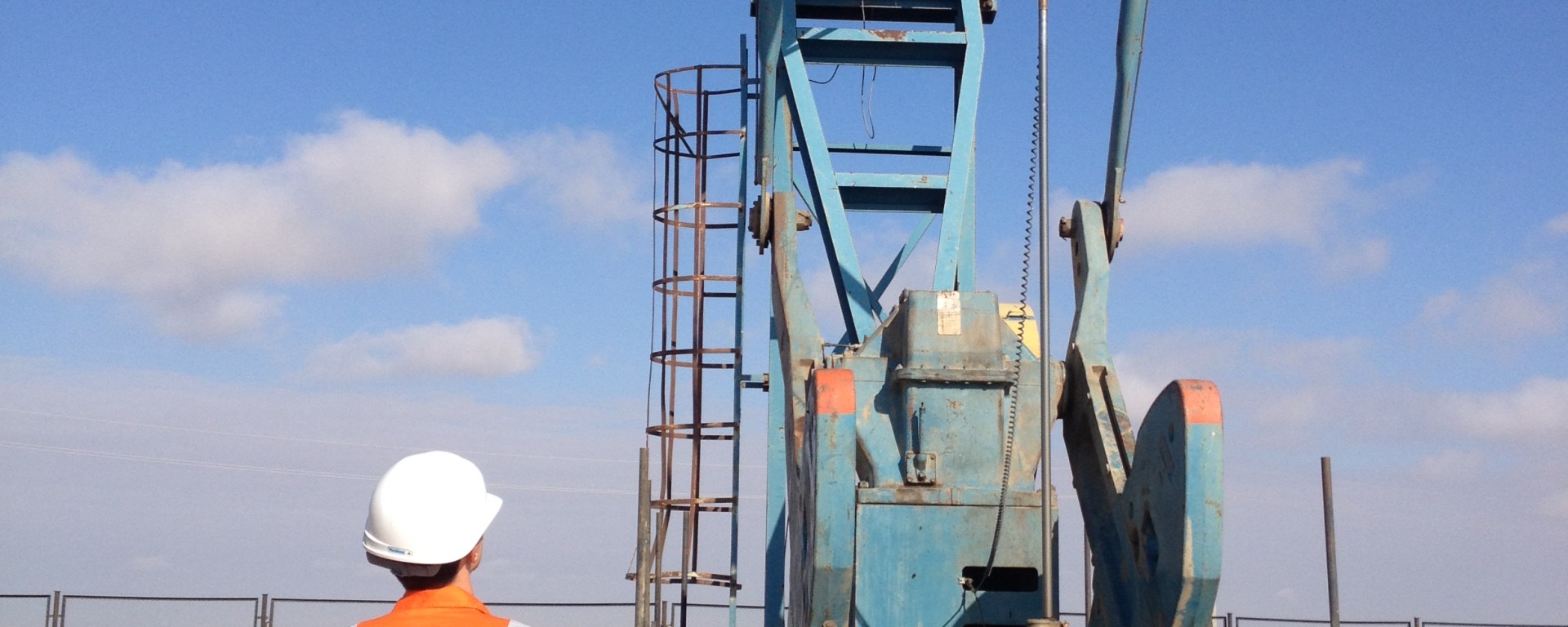
The picture above is taken in Kazakhstan in 2014 in Maersk Oil operated field Dunga, near the town of Aktau.
The science behind exploration, development and production of hydrocarbons from an oil and gas field is fascinating. The main risk in oil and gas exploration is if there is hydrocarbon in the area of interest and if there is the uncertainty is how much. This is because we can’t clearly see the subsurface or because the technology and the infrastructure is not able to handle the extraction.
However, human kind has developed advanced technologies to minimize the risk and uncertainly as much as possible. Almost all natural sciences are applied in the problem of finding and producing oil and gas. Geologists look at deposition environments and known basins to determine the areas where hydrocarbon could be stored as well as the rock types; geophysicists look at seismic to “see” the subsurface; engineers look for ways to produce the hydrocarbon and maintain or enhance the levels of production; chemical engineers look at the composition of the produced hydrocarbon to determine its quality; mechanical and electrical engineers look at the facilities on the surface and an enormous number of specialized people working together for the sole purpose of producing oil and gas.
Why? Oil and gas are bad. They contaminate the environment (air, land, water), increase the carbon emission, destroy people lives. A lot of people tell me I am biased when it comes to this topic, but I would say I am realistic and I am knowledgeable enough as to what actually happens. The negative impression and furious media coverage for the oil industry is beyond the logic of the reality in my opinion. Would anyone imagine life without oil? You would’t be able to go anywhere and the world wouldn’t be as we know it today. Do people know about casing and cementing of the wells (to prevent contamination of underground water sources); about the carbon cycle, about the organic origin of oil and gas; about the economic growth that oil and gas gives to countries where it is produced. What about the petrochemical industry? Do you know that plastic and some type of textile is produced from an oil field from the processing of the hydrocarbons? Why does no one talk about these?
Only nuclear power is a more efficient energy source than hydrocarbon. Oil (and compressed or liquefied gas) is transportable and that quality makes it so valuable to us. Coal is the highest CO2 generator in the world and that is used vastly also in US to generate power. That is the number one problem, not oil! Using nuclear energy will cater for this issue. So will building wind farm and solar panel infrastructure. That would have a significant impact on the amount CO2 emissions and not the immediate substitution of oil. Solar panels and wind farms have two major issues; the cost of building a new grid and the physical space. You need lots of units and a lot of land to get significant amount of energy produced.
Oil and gas companies are significant sources for R&D and technological advancement. Image processing of seismic data, drilling, various EOR techniques etc are products of the need to increase the production of oil and gas. Sciences come together for a purpose that helps people transport themselves everyday throughout the globe.
Oil is of course a finite resource. But we all know that today there is so much more oil to be discovered and produced. We constrain ourselves from its production due to numerous political and economical reasons. Oil prices or fiscal constrains imposed by the governments makes the development of some of the oil fields not economical. I don’t understand why do we do it! People should know the whole truth and should be realistic about the problems and understand the whole picture.
 Ledian Selimaj